

Five Early Warning Signs Your Transformation Is at Risk
Updated: Jul 31
Enterprise transformations rarely fail because of a single event. More often, they begin to lose momentum as decision-making slows, priorities become fragmented, risks accumulate, and executive visibility declines. These issues typically emerge long before missed milestones or budget overruns become apparent.
Recognizing the early warning signs is essential for maintaining control. This article highlights five common indicators that a transformation is at risk and explains how executive leaders can intervene early to strengthen governance, improve execution, and protect strategic outcomes.
Executive Summary
Most enterprise transformations do not fail overnight. They gradually lose control as small execution issues accumulate into major delivery problems. Governance meetings continue, projects appear to be progressing, and status reports remain largely positive—until missed milestones, escalating costs, and declining stakeholder confidence reveal a different reality.
The organizations that recover successfully are rarely those with the best recovery plans. They are the ones that recognize the warning signs early enough to intervene before execution becomes unstable.
This article outlines five common indicators that a transformation is beginning to lose control. While each warning sign may appear manageable in isolation, together they often signal deeper weaknesses in governance, decision-making, and delivery discipline. Recognizing these patterns early enables leaders to restore alignment, improve visibility, and prevent manageable issues from becoming enterprise-wide failures.
Why Transformations Rarely Fail Suddenly
Enterprise transformations involve multiple programs, competing priorities, cross-functional dependencies, changing business requirements, and significant investment. Complexity itself is not the problem. The challenge is maintaining executive control as complexity increases.
Many leadership teams assume that if projects continue to report green status and governance meetings occur regularly, the transformation is progressing as planned. Unfortunately, execution problems often remain hidden until they affect strategic outcomes.
By the time budget overruns become visible or delivery deadlines are missed, the underlying issues have typically existed for months.
The earlier these issues are identified, the less disruptive—and less expensive—they are to resolve.
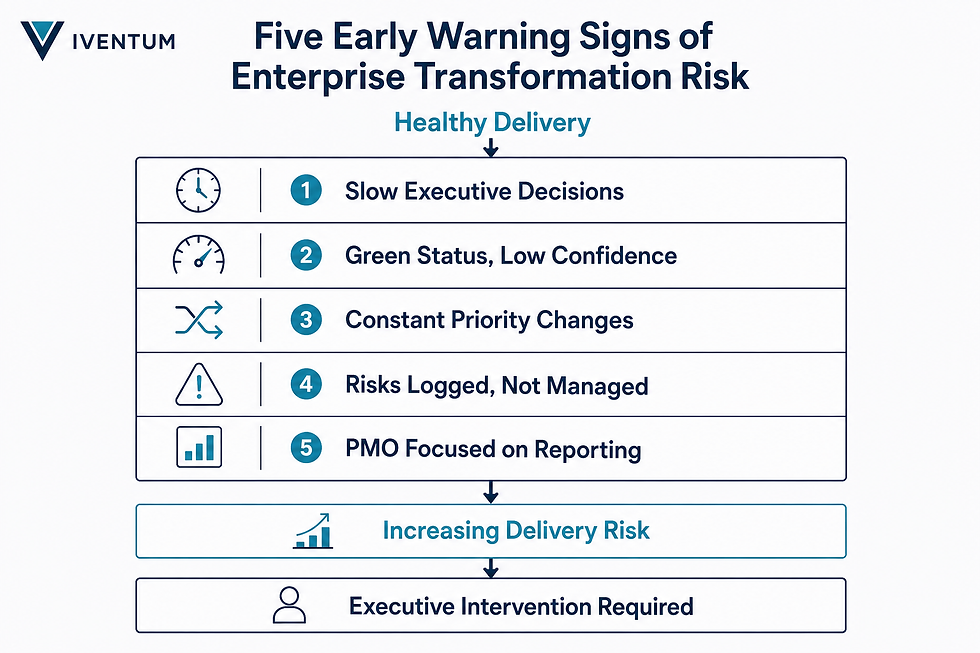
Warning Sign 1: Executive Decisions Are Taking Too Long
One of the earliest indicators of a transformation under pressure is slowing decision-making.
Projects often require timely executive decisions regarding funding, scope, priorities, resources, or risk acceptance. When these decisions become delayed, delivery teams begin making assumptions or waiting for direction. Both outcomes introduce uncertainty.
Common indicators include:
Decisions repeatedly deferred to future governance meetings
Escalations remaining unresolved for weeks
Multiple approval layers slowing execution
Teams proceeding without executive clarity
The consequence is predictable. Delivery slows, dependencies accumulate, and risks increase—not because projects lack capability, but because leadership decisions are not keeping pace with execution.
Warning Sign 2: Every Project Reports Green—but Leadership Lacks Confidence
Perhaps the most recognizable warning sign is the "green dashboard syndrome."
Project reports consistently indicate that initiatives are on track, yet executives sense that something is wrong. Milestones continue to move, issues appear unexpectedly, and delivery confidence declines despite positive reporting.
This usually reflects poor reporting rather than healthy delivery.
Typical causes include:
Status reporting focused on activities instead of outcomes
Inconsistent reporting standards across programs
Risks understated to avoid escalation
Lack of objective delivery metrics
Healthy transformations create transparency rather than optimism.
Executives need visibility into delivery confidence, emerging risks, and strategic impact—not simply traffic-light reporting.
Warning Sign 3: Strategic Priorities Continue to Change
Transformation portfolios often begin with clear objectives. Over time, however, new initiatives emerge, business priorities shift, and additional projects compete for the same resources.
Without disciplined portfolio governance, organizations gradually lose strategic focus.
Symptoms include:
New projects added without removing others
Resources spread across too many initiatives
Frequent reprioritization
Teams working on competing objectives
Eventually, everything becomes important—and therefore nothing receives sufficient attention.
Successful organizations continuously align their portfolio with strategic outcomes rather than treating the annual project list as fixed.
Warning Sign 4: Risks Are Identified—but Rarely Managed
Many organizations maintain comprehensive risk registers.
Far fewer actively manage enterprise risks.
When governance focuses on documenting risks rather than resolving them, the transformation becomes reactive instead of proactive.
Typical warning signs include:
The same risks appearing month after month
Risks discussed without assigned ownership
Dependencies creating recurring delivery delays
Escalations without follow-up actions
Risk management should support decision-making, not administration.
Effective governance identifies risks early, assigns accountability, and ensures corrective action before issues affect delivery.
Warning Sign 5: The PMO Becomes a Reporting Function Instead of a Leadership Capability
High-performing PMOs create clarity, alignment, and execution discipline.
Underperforming PMOs often become reporting organizations whose primary responsibility is collecting project updates and producing governance packs.
This shift usually occurs gradually.
Indicators include:
Success measured by report quality rather than delivery outcomes
Limited authority to challenge project status
Minimal involvement in executive decision-making
Focus on compliance rather than performance
When this happens, executives lose one of their most valuable mechanisms for maintaining control.
A strategic PMO should enable better decisions—not simply better reporting.
The Hidden Pattern Behind These Warning Signs
Although these warning signs appear different, they typically originate from the same underlying causes:
Governance focused on reporting instead of decisions
Limited executive visibility across the portfolio
Weak prioritization discipline
Unclear accountability
Reactive rather than proactive intervention
None of these problems emerge overnight.
They develop gradually as transformation complexity outpaces leadership capacity.
This explains why many organizations continue believing delivery is under control until multiple issues appear simultaneously.
From Early Signals to Delivery Failure
A transformation rarely moves directly from healthy execution to failure.
Instead, it follows a predictable progression.
Minor Delivery Issues
          ↓
Decision Delays
          ↓
Growing Dependencies
          ↓
Reduced Executive Visibility
          ↓
Missed Milestones
          ↓
Loss of Stakeholder Confidence
          ↓
Transformation Recovery
The objective is not simply to detect problems.
It is to intervene before they begin affecting strategic outcomes.
How Executive Teams Can Respond Early
Organizations that consistently deliver complex transformations share several characteristics.
They establish governance that accelerates decision-making rather than adding bureaucracy.
They maintain clear visibility across the portfolio using objective delivery indicators.
They actively manage cross-program dependencies instead of addressing them only after delays occur.
Most importantly, they intervene early.
Rather than waiting for projects to move into formal recovery, they identify trends that indicate declining delivery confidence and act before those trends become failures.
Early intervention is significantly less disruptive than large-scale recovery efforts.
Executive Self-Assessment
Consider the following questions:
Are executive decisions consistently made within the required timeframe?
Does leadership have confidence in delivery reporting?
Are strategic priorities reviewed regularly?
Are enterprise risks actively managed rather than simply documented?
Does your PMO influence executive decisions or primarily produce reports?
If multiple answers raise concerns, your transformation may already be showing early signs of losing control.
Fortunately, these issues are often reversible when identified early.
Key Takeaways
Enterprise transformations rarely fail without warning.
Decision delays often precede delivery delays.
Positive project reporting does not always indicate healthy execution.
Weak portfolio prioritization reduces strategic impact.
Effective PMOs enable leadership decisions, not just reporting.
Early intervention significantly improves transformation outcomes.
Conclusion
By the time major delivery failures become visible, organizations have often been operating with declining governance effectiveness, slowing decision-making, and limited executive visibility for months.
The most successful transformation leaders recognize that maintaining control is not about monitoring more metrics—it is about identifying the right signals early enough to act.
Organizations that consistently deliver complex transformations build governance systems that reveal problems before they become crises. They prioritize transparency over optimism, accountability over administration, and decisive leadership over delayed consensus.
Enterprise transformation is ultimately a leadership challenge. The earlier leaders recognize the warning signs, the greater their ability to restore control, protect strategic investment, and deliver lasting business outcomes.
Request an Assessment
If your transformation is experiencing delayed decisions, fragmented governance, declining delivery confidence, or competing priorities, it may be time to reassess how execution is being managed.
IVENTUM helps organizations restore control across complex enterprise transformations by creating stronger governance, clearer execution visibility, and the decision discipline required to deliver strategic outcomes.
A focused transformation assessment can identify where control is being lost, prioritize the most critical improvements, and establish a practical roadmap for restoring execution momentum before risks become costly failures.
References
Project Management Institute (PMI)
Pulse of the Profession® 2026: Driving Success in Complex Projects — From Navigating Tasks to Navigating Systems
Research on enterprise complexity, execution challenges, decision-making effectiveness, and the capabilities required to successfully deliver complex initiatives.
McKinsey & Company
The Inconvenient Truth About Change Management: Why It Isn’t Working and What to Do About It
Research on why transformation programs struggle, including leadership alignment, organizational readiness, and the need for stronger execution discipline.
Boston Consulting Group (BCG)
Agile Transformation Management: Managing Large-Scale Change in a Fast-Changing World
Insights on improving transformation outcomes through executive ownership, portfolio visibility, dependency management, and faster decision-making.
Harvard Business Review (HBR)
Why Strategy Execution Unravels—and What Leaders Can Do About It
Research on the leadership, organizational, and execution barriers that prevent strategic initiatives from delivering intended outcomes.
